

Pediatric ABA Therapy: Reclaiming the Critical Years of Development
Choosing pediatric ABA therapy is often the first decisive action a parent takes after an autism diagnosis. It is the moment you stop wondering “what if” and start asking “what is possible.” For families with children aged eighteen months to twelve years, the period following a diagnosis is often defined by a mixture of relief and overwhelming anxiety. You see the potential in your child’s eyes, but you also see the frustration when they cannot communicate their needs or the social isolation they face when they cannot join their peers in play.
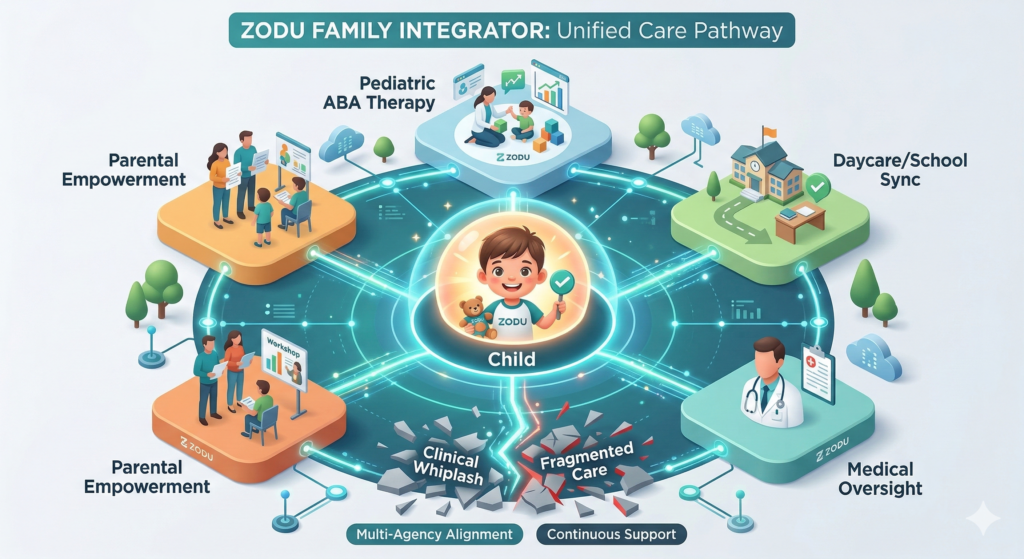
This journey is about more than just managing symptoms; it is about building a foundation of skills that will last a lifetime. At ZODU, we understand that for a child, every day is a critical learning window. Our approach within the Integrated Family Health System ensures that your child’s therapy is not an isolated event, but a coordinated effort that involves the home, the clinic, and the classroom.

Surviving the “Wait-List Limbo”
In the world of autism support, the most dangerous enemy isn’t the diagnosis; it is Wait-List Limbo. This is the true villain in your story. It is the fragmented system that gives you a diagnosis and then tells you to wait six months for an evaluation while your child misses vital developmental milestones.
This systemic failure creates a high-stakes environment where:
- Time is Lost: Every month spent waiting is a missed opportunity for Early Intervention ABA Therapy.
- Families are Isolated: You are left to manage challenging behaviors alone without a professional roadmap.
- Clinical Fragmentation: You might find a therapist, but they don’t communicate with your pediatrician or the school, leading to “Clinical Whiplash.”
- Parental Burnout: You spend your life as a “case manager,” fighting for authorizations instead of enjoying your child’s growth.
Families don’t have to navigate alone. ZODU was established to eliminate these gaps. We act as your Family Integrator, bridging the space between medical providers and behavioral experts to provide one clear path to health.
The ZODU Difference: A System Designed for Families
We started ZODU because we saw too many parents losing themselves in the administrative chaos of special education and healthcare. We believe that when your full-time job becomes managing a dozen disconnected therapists, the system is broken.
Our applied behavior analysis for kids is designed to absorb that burden. We provide:
- Fewer Handoffs: We coordinate internally between our therapy, nursing, and behavioral teams.
- Coordinated Referrals: We manage the links between your pediatrician and our clinical staff.
- Shared Care Plans: One unified strategy that travels with your child from the home to the clinic.
We empower you to move from being an exhausted coordinator back to being a parent, knowing that your child’s Coordinated Ecosystem of Care is handled by experts.
The Pediatric Development Matrix: Core Skill Domains
Our pediatric ABA therapy programs are tailored to the specific developmental stage of your child, focusing on the “Building Blocks” required for authentic independence.
Early Intervention (Ages 18 Months – 5 Years)
- Functional Communication: Replacing frustration-based meltdowns with vocalizations, signs, or PECS.
- Learning Readiness: Building the “attending” skills needed for a classroom setting, such as sitting and following simple directions.
- Play Skills: Moving from isolated play to parallel and interactive play with peers.
School-Age Support (Ages 6 – 12 Years)
- Social Pragmatics: Understanding the unwritten rules of social interaction and conversation.
- Daily Living Skills: Mastering self-care routines like dressing, hygiene, and mealtime independence.
- Emotional Regulation: Providing the tools to identify and manage big feelings in high-pressure school environments.
Myths vs. Facts: Child Behavior Therapy Autism
Navigating the search for ABA therapy for children requires cutting through common misconceptions to find the clinical truth:
- Myth: ABA is only for children with severe behavioral issues.
- Fact: Applied behavior analysis for kids is effective for a wide range of needs, including social skill development and language acquisition for high-functioning children.
- Myth: Therapy must happen in a clinic to be effective.
- Fact: We utilize “Natural Environment Teaching.” Some of the best progress happens at the dinner table or on the school playground.
- Myth: ABA therapy makes children lose their “spark.”
- Fact: Our goal is to unlock your child’s personality, not change it. We provide the tools they need to express that spark to the world.
The Roadmap: Your Clinical Journey to Mastery
At ZODU, we move your family through a structured, data-driven pathway to ensure transformation is measurable and sustainable.
- Observe: We conduct deep-dive assessments to understand the “why” behind your child’s behaviors in their natural environment.
- Communicate: We will meet with your child’s existing medical and educational teams to ensure a unified approach.
- Coordinate: We design a Shared Plan of Care that integrates clinical goals with your family’s daily life.
- Transform: Through consistent intervention and parent training, we move toward the goal of functional independence.
What to Expect: The ZODU Fast-Track Intake
We respect your time because we know every day counts in early intervention ABA therapy. Our intake process is built for speed and clinical accuracy:
- Discovery Call: We gather your child’s history and identify your family’s primary goals.
- Eligibility Check: We handle the complex insurance verification and authorization process for you.
- Clinical FBA: A Board Certified Behavior Analyst (BCBA) conducts a Functional Behavior Assessment to build the treatment roadmap.
- Therapist Match: We pair your child with a Registered Behavior Technician (RBT) who fits your child’s personality and needs.
With ZODU’s integrated system, your next step isn’t just a therapy session; it’s entering a coordinated care pathway.
Phone: 407-559-7093
Email: Clientcare@zoducounseling.com
Key Terms for Family Clarity
- Pediatric ABA therapy: A specialized branch of behavior analysis focused on the developmental needs of children from infancy through age twelve.
- Early intervention ABA therapy: High-intensity behavioral support provided during the most receptive years of brain development (ages 0-5).
- Applied behavior analysis for kids: The scientific application of learning principles to help children acquire new skills and reduce challenging behaviors.
- Child behavior therapy autism: A goal-oriented clinical approach to helping children with ASD navigate social and environmental demands.
Frequently Asked Questions
How many hours of pediatric ABA therapy will my child need?
This is determined by the BCBA after a formal assessment. Comprehensive programs often range from 25–40 hours per week, while focused programs may be 10–20 hours.
Can ZODU provide ABA therapy in my child’s school?
Yes. We coordinate with school administrators to provide school-based support, ensuring that the strategies used in therapy are reinforced in the classroom.
What is the role of the parent in this process?
You are our most vital partner. We provide regular parent training and “warm handoffs” to ensure the progress made in therapy continues long after the therapist leaves.
Is there a waiting list for ZODU services?
We strive to eliminate “Wait-List Limbo.” Our fast-track intake process is designed to get your child into assessment and therapy as quickly as clinical standards allow.
Related ZODU Services and Resources
Explore ZODU ABA Services for professional clinical support and integrated system coordination within your local community. Learn more about how we coordinate Behavior Therapy and Rehabilitative Care through a shared clinical plan. Download the official [suspicious link removed] to better understand the professional pathways available for your child’s healing.
