

- 8 December 2025
- prduany
- No Comments
- Blog
It’s natural to feel worried when your child struggles to communicate their thoughts or feelings. You are not alone in seeking answers. Finding the right support is the most important step you can take.
Pediatric speech therapy provides a clear, proven path for children to develop strong communication skills. Our children’s speech therapy services help kids overcome hurdles related to talking, listening, reading, and even feeding. We specialize in effective speech therapy for toddlers that families trust.
This guide will explain how our expert Speech-Language Pathologist specialists work. Our goal is to empower your child to succeed socially, academically, and confidently.
Understanding Speech Therapy for Children: What is an SLP?
Speech therapy is the treatment for children and adults who have difficulty with speech or language.
When we focus on speech therapy for kids, we look at communication as the foundation for all growth. This includes not just making sounds, but also understanding language, expressing ideas, and even the coordination needed for safe eating.
A Speech-Language Pathologist (SLP), often called a speech therapist, is a highly trained professional. Our SLP specialists assess all aspects of communication and swallowing to create personalized treatment plans.
The Difference: Speech Disorders vs. Language Disorders
Understanding the difference between speech and language helps define the right course of action. Both are critical focus areas for children’s language therapy and speech remediation.
Speech Sounds and Fluency (Articulation, Stuttering)
Speech disorders refer to problems with the physical act of making sounds.
- Articulation Disorders: When a child has trouble producing specific sounds (e.g., saying “wabbit” instead of “rabbit”). Our therapy focuses on training the tongue, lips, and jaw muscles based on motor planning principles. Studies show that early intervention using these strategies improves sound accuracy significantly.
- Fluency Disorders: This involves disruptions in the flow of speech, like stuttering (unusual blocks or repetitions). We use supportive techniques to reduce anxiety and promote smooth, rhythmic speech.
Understanding and Expressing Ideas (Receptive and Expressive)
Language disorders relate to how a child understands and uses words.
- Receptive Disorders: Difficulty processing or understanding what others are saying. Therapy uses engaging activities, pictures, and repetition to strengthen comprehension skills.
- Expressive Disorders: Difficulty putting words together, having a limited vocabulary, or being unable to use language appropriately in social settings. We focus on building vocabulary and sentence structure through interactive play.
Real-World Example: A child might clearly say words (good speech) but struggle to follow a two-step direction in school (language disorder). Our pediatric speech therapy addresses both sides of communication.
Support for Feeding and Swallowing (Oral-Motor Skills)
Speech therapists also help with dysphagia or oral feeding disorders. This involves problems with chewing, swallowing, or managing different food textures. We use gentle oral exercises to strengthen the necessary mouth muscles for safe eating.
How Our SLP Specialists Support Your Child’s Growth
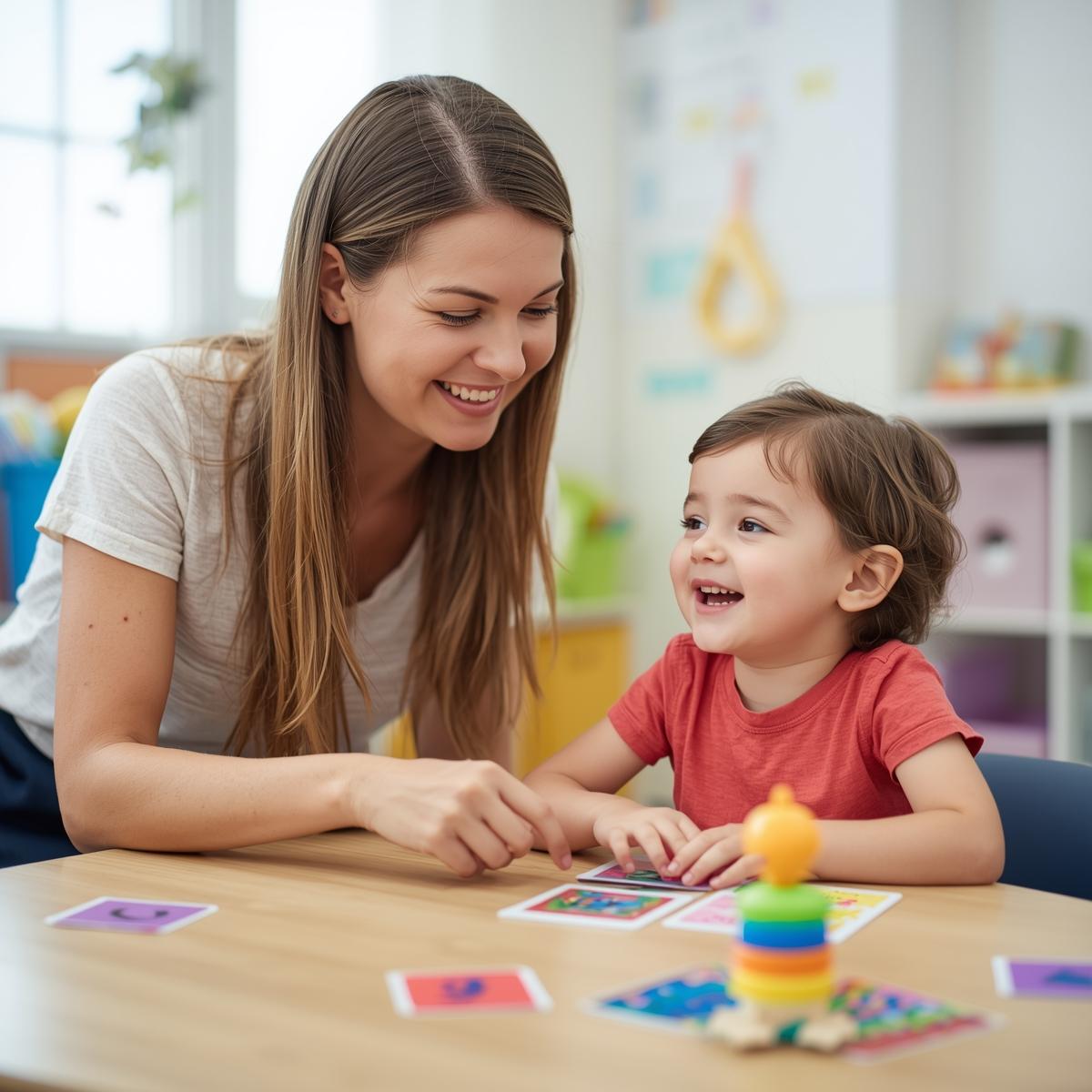
Therapy is always engaging and play-based. We use evidence-based strategies to make learning effective and fun. This supports families everywhere.
Language Intervention Activities
We interact with your child using age-appropriate games, books, and play. The therapist models correct grammar and vocabulary. This encourages conversation and interaction.
This method is rooted in responsive language interaction, a proven way to organically build language pathways.
Articulation Therapy
We gently show your child how to position their mouth and tongue to produce difficult sounds. This practice is often done through fun, goal-oriented play.
Real-World Example: We might use bubbles or straws to strengthen the mouth muscles. This directly prepares the child to correctly form sounds like ‘sh’ or ‘s’.
Cognitive-Communication Therapy
For children struggling with attention or memory, we use word games and problem-solving activities. This helps maintain cognitive function, improving the connection between their brain and language.
Research confirms that engaging tasks like these enhance memory and problem-solving abilities crucial for complex communication.
Real-World Example: If a child frequently gets frustrated because their family cannot understand them, speech therapy for children gives them the tools to speak clearly. This small victory prevents tantrums and drastically improves family harmony.
When to Consider a Pediatric Speech Therapy Evaluation
Early intervention is highly effective, and it’s always best to check if you have any concerns. Our SLP specialists recommend a pediatric speech evaluation if your child shows signs of delays compared to their peers.
We often help children with conditions such as:
- Autism Spectrum Disorder (ASD)
- Developmental Delays
- Hearing Impairments
- Cleft Lip or Palate
- Fluency Disorders (Stuttering)
- Selective Mutism or Social Communication Disorders
Schedule a free orientation to understand your child’s next steps.
If you’d like guidance, our team is here to help. We understand that taking the first step requires courage, and we are committed to making the process easy and supportive.
- Book a complimentary orientation
- Call us to discuss your child’s needs
Frequently Asked Questions (FAQs)
What is the best age to start speech therapy?
There is no “best” or “most correct” age. However, studies consistently show that children who start speech therapy for kids early (before age 5) often see faster results.
If you have any concerns about your child’s communication milestones, an evaluation by a qualified SLP should be done as soon as possible.
How do I know if my child needs children’s speech therapy?
Look for common warning signs. These include talking infrequently, difficulty forming words clearly, or trouble understanding simple directions. You should also look for children who get easily frustrated when trying to communicate.
If you are seeking support, contact us for an initial screening.
What activities happen during a session?
For kids, therapy usually involves play! Your Speech-Language Pathologist uses engaging, age-appropriate play, books, and language-based games.
The goal is to make the child forget they are “working” while they practice key skills.
How long does the therapy process take?
Every child’s needs are unique. Some disorders improve quickly, while others require longer support.
The duration of pediatric speech therapy depends on the severity of the challenge, the consistency of practice at home, and the child’s age. Your SLP will set clear, achievable goals.
Does insurance cover speech therapy for kids?
Coverage varies widely depending on your specific insurance provider and plan.
Our clinic provides personalized pediatric speech therapy services based on each child’s needs. We recommend contacting your insurance company directly to understand your benefits, deductibles, and co-pays.
Is the speech therapist the same as a reading specialist?
They are similar but distinct. Reading specialists focus on literacy skills (decoding, phonics).
SLPs address the underlying language skills (like phonological awareness and comprehension) that are essential for reading. Often, children receive support from both professionals.
