
Choosing behavioral therapy for autism is an act of profound courage for a parent. It marks the moment you decide that your child’s challenges do not define their future. For many families in Florida, the daily reality of raising a child with Autism Spectrum Disorder (ages 2–18) is often a cycle of high-tension moments, meltdowns in the grocery store, the heavy silence of a non-verbal toddler, or the heartbreak of watching your teenager struggle to make a single friend.
You aren’t just looking for “therapy”; you are looking for a translator for your child’s inner world. You need a way to turn those overwhelming outbursts into functional requests and those isolated moments into social connections. At ZODU, we recognize that this journey is deeply personal. Our approach within the Integrated Family Health System is designed to provide more than just clinical data; we provide the professional framework that allows your family to finally breathe again.

Navigating the “Spectrum of Chaos”
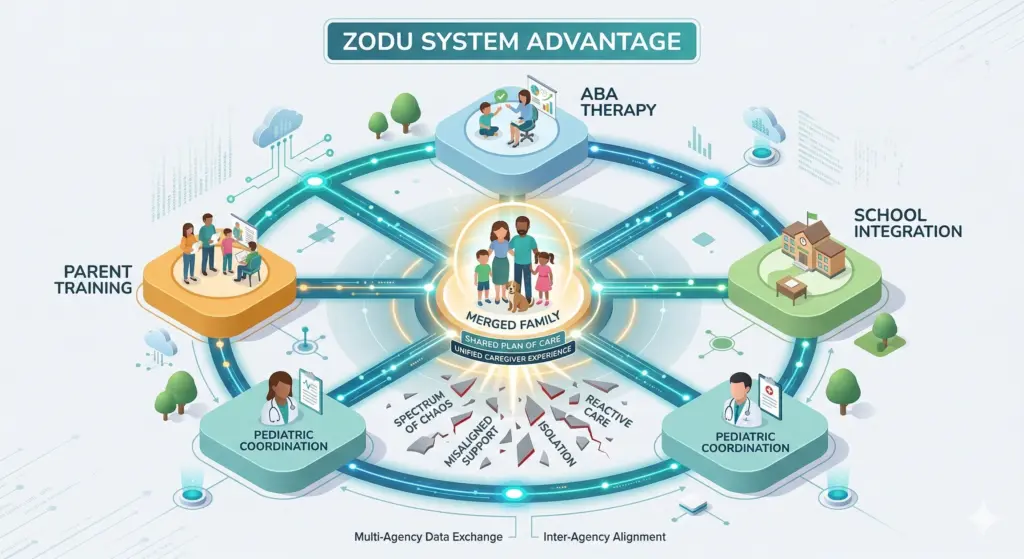
The primary obstacle for parents isn’t the autism diagnosis itself; it is the Spectrum of Chaos created by a fragmented healthcare system. This is the true villain in your story. It is the state where you are forced to manage an RBT at home, a teacher at school, and a pediatrician in a clinic, none of whom ever speak to each other.
This lack of coordination leads to “Clinical Whiplash,” where:
- Your child is confused by conflicting strategies from different providers.
- You are exhausted from acting as a full-time “therapy coordinator” instead of just being a parent.
- Insurance authorizations feel like a secondary battleground that drains your emotional energy.
- Progress made in the clinic disappears the moment your child steps back into the “real world” of your living room.
Families don’t have to navigate alone. When care is bikhri hui (scattered), your child’s potential remains locked behind a wall of inconsistency. ZODU was built to destroy this siloed approach, replacing it with a Coordinated Ecosystem of Care where everyone is reading from the same playbook.
The ZODU Difference: From Case Manager to Parent
We started ZODU after watching too many parents lose their own identities to the administrative demands of their child’s disability. When your marriage is tested by arguments over therapy approaches and your other children start to feel invisible, the system has failed you.
Our applied behavior analysis therapy is designed to return you to your rightful role. We take on the heavy lifting of coordination, allowing you to stop being a case manager and start being a mom or dad again. We believe that behavioral therapy for autism is only successful when it stabilizes the entire household, not just the individual child.
Core Pillars of Our Behavioral Intervention
Our licensed experts focus on four critical domains to ensure your child develops the skills needed for a life of purpose:
- Communication Mastery: Moving from grunts and pointing to functional speech, signs, or PECS (Picture Exchange Communication System).
- Behavioral Regulation: Identifying the “why” behind meltdowns and replacing them with healthy coping mechanisms.
- Social Fluency: Teaching the “unwritten rules” of interaction, from eye contact and turn-taking to complex peer relationships for teenagers.
- Daily Living Independence: Mastering the small wins that lead to big freedom, such as self-feeding, dressing, and personal hygiene.
Myths vs. Facts: Understanding Autism Behavior Therapy
There is a lot of misinformation surrounding autism behavior therapy. Understanding the clinical reality helps you make better decisions for your child’s future:
- Myth: ABA therapy is just “robot training” for compliance.
- Fact: Modern applied behavior analysis therapy at ZODU is play-based and person-centered. We focus on giving your child the tools to advocate for their own needs, not just to follow orders.
- Myth: You have to choose between school and therapy.
- Fact: We believe in a Shared Plan of Care that integrates into your child’s school day, home life, and community activities.
- Myth: It is “too late” to start therapy for a teenager.
- Fact: While early intervention is vital, the brain remains plastic. Behavioral therapy for adolescents focuses on vocational skills, emotional control, and independence.
The Journey: Your Roadmap to Functional Independence
At ZODU, we don’t just provide sessions; we guide you through a phased clinical journey. This ensures that progress is sustainable and that you always know what the next milestone looks like.
- Observation & Connection: We start by seeing the whole story. We observe your child in their natural environment to understand their unique triggers and strengths.
- Strategic Coordination: We build a bridge between your medical providers, teachers, and our therapists. No more playing “telephone” with your child’s health.
- Active Transformation: Using data-driven Applied Behavior Analysis Orlando techniques, we begin the work of shaping new behaviors and unlocking communication.
- Sustainable Maintenance: We transition from intensive support to a maintenance phase where the child and the family hahavehe internal tools to thrive independently.
What to Expect: The ZODU Fast-Track Intake
We know that when you reach out for help, you are often at your breaking point. Our intake process is designed to be respectful, professional, and fast:
- Step 1: The Initial Discovery (Day 1-3): A brief call to understand your child’s history and your family’s biggest “pain points.”
- Step 2: Insurance & Eligibility (Day 3-5): Our team handles the complex verification process so you don’t have to spend hours on hold with insurance companies.
- Step 3: The Clinical Assessment (Day 7-10): A Board Certified Behavior Analyst (BCBA) conducts a deep-dive Functional Behavior Assessment (FBA).
- Step 4: The Coordinated Launch: We match your child with the right RBT and begin services with a unified plan already in place.
With ZODU’s integrated system, your next step isn’t just a therapy session; it’s entering a coordinated care pathway.
Phone: 407-559-7093
Email: Clientcare@zoducounseling.com
Key Terms for Family Awareness
- Behavioral therapy for autism: A clinical framework used to improve social, communication, and learning skills through positive reinforcement.
- Applied Behavior Analysis (ABA): The scientific study of behavior that identifies how the environment influences a child’s actions.
- Positive Reinforcement: Encouraging a desired behavior by offering a rewarding stimulus after the behavior is performed.
- Functional Behavior Assessment (FBA): A process used to determine the specific “purpose” of a challenging behavior (e.g., escape, attention, or sensory).
Frequently Asked Questions
Is ABA therapy for autism covered by insurance in Florida?
Yes, most major commercial plans and Florida Medicaid are required to cover behavioral therapy for autism when it is medically necessary. Our team will verify your specific coverage during intake.
Can we do therapy at home and at the clinic?
Absolutely. We believe in “Natural Environment Teaching.” Progress is most stable when it happens where real life happens, at the dinner table, in the park, and in the classroom.
How many hours of therapy will my child need?
This is determined by the BCBA after the FBA. Some children benefit from “focused” ABA (10-20 hours), while others require “comprehensive” support (25-40 hours).
How does ZODU involve the parents?
You are the most important member of the team. We provide regular parent training and “warm handoffs” to ensure you feel confident using the same strategies we use.
Related ZODU Services and Resources
Explore ZODU ABA Services for professional clinical support and integrated system coordination within your local community. Learn more about how we coordinate Behavior Therapy and Rehabilitative Care for children through a shared clinical plan. Download the official Applied Behavior Analysis (ABA) for Autism – Parent Guide (CDC PDF) to better understand the professional pathways available for your child’s healing.